 |
| October 06, 2026 | Volume 22 Issue 37 |
Electrical/Electronic News & Products
Designfax weekly eMagazine

Archives
Partners
Manufacturing Center
Product Spotlight
Modern Applications News
Metalworking Ideas For
Today's Job Shops
Tooling and Production
Strategies for large
metalworking plants
Be one of the first to harness next-gen Edge AI
 SECO's new SOM-SMARC-Dragonwing-IQ8 is the world's first industrial SMARC module powered by Qualcomm Dragonwing™ IQ8 technology. Delivering 40 TOPS of AI performance, high-speed industrial connectivity, and seamless Arduino transition, it is purpose-built for robotics, vision, and autonomous systems. OEM evaluation samples are limited -- request yours today to start building.
Learn more.
The 7 best ways to automate your SOLIDWORKS designs
 According to the experts at Hawk Ridge Systems, automating tasks in SOLIDWORKS is a great way to improve productivity and make your life easier. Learn about SOLIDWORKS' many automation capabilities including: tools for automated drawing generation, design tables, custom macros, global variables and equations, and brand-new AI-based tools built directly into SOLIDWORKS. See how these features can help you work more efficiently.
View the video.
How standard AI is messing up industrial automation quotes
 Reshape Automation's new Industrial AI Accuracy Index 2026 tested three leading AI models -- GPT-6 Astra, Claude, and Gemini -- on 100 questions drawn from what customers ask distributors and OEMs every day, covering parts from 14 industrial manufacturers. From memory alone, the models got 12% to 14% right. With web search, the best scored 52%. About 1 in 3 wrong answers gave a specific part number or figure with no caveat.
Read the full article.
Engineer's Toolbox: What is ground loop feedback?
 Improper grounding can create problems in data logging, data acquisition, and measurement and control systems. One of the most common problems is known as ground loop feedback. Experts at CAS DataLoggers run through five ways to eliminate this problem.
Read the full article.
New pressure transmitters from AutomationDirect
 Automation-Direct's new MP Sensor Inline pressure transmitters plug directly into pneumatic lines via built-in push-in connections from 5/32" to 3/8" (and 6 mm). Ultra-compact and mountable anywhere, they deliver +/-0.5% accuracy, IP68 durability, and versatile outputs (4-20 mA, NPN/PNP, IO-Link). Need touch control? The new P.Touch series adds a TFT touchscreen for effortless setup and sub-3ms response.
Learn more and get all the specs.
High-capacity benchtop video measurement system
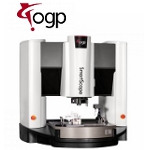 Optical Gaging Products has introduced the SmartScope® E18, a compact, benchtop video measurement system. Featuring a 12" x 12" stage, IntelliCentric™-E fixed-lens optics, and VIRTUAL ZOOM™ technology, it offers fully automatic 3-axis performance without taking up floor space. Standard LED lighting, a rigid fixed-bridge design, optional touch probes, and advanced metrology software ensure accurate, repeatable inspection.
Learn more.
Tech Tip: Fan selection - Why airflow is not just CFM
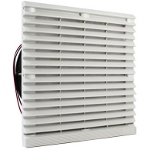 For many engineers, fan selection starts and ends with a single number: CFM (cubic feet per minute). Higher CFM feels like a clear win. More air moved must mean better cooling. However, in practice, this assumption is one of the most common causes of thermal problems, excess noise, and late-stage redesigns. Find out why.
Read this Orion Fans technical article.
Useful! Snap-together LED enclosure lighting
 Seifert StripLite SL 4000 Series LED enclosure lighting provides bright illumination to 700 lumens. On/off switch and motion sensor models are available. Easily daisy chain up to 16 light strips. Magnetic or clip mounting. See video/info on website or contact Bristol Instruments for more information.
Learn about snap-together lighting.
The hidden hardware helping AI's heat problem: PCHEs
 Across AI infrastructure, thermal constraints now connect semiconductor design with power and cooling systems. More compact, lighter, and efficient than conventional shell-and-tube models, printed circuit heat exchangers save floor space, reduce energy costs, and improve overall efficiency in dense, hyperscale environments.
Read the full article.
Nearly 1,000 parts: Industrial enclosure range expanded
 Altech Corp. has expanded its industrial enclosure lineup to 10 unique series with nearly 1,000 parts! Designed for control, junction, and terminal applications, these plastic and aluminum housings offer up to IP69 protection. They mount directly to walls or panels, resisting chemicals, corrosion, flames, impacts, and severe outdoor conditions without sacrificing aesthetics.
Find your perfect enclosure today.
Cool Tools: MetraSCAN BLACK2 -- Next-gen shop-floor 3D inspection
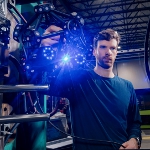 You'll gain some superhero powers when you brandish FARO CREAFORM's new MetraSCAN BLACK2, a next-gen portable metrology-grade optical 3D scanner engineered to deliver total inspection flexibility on the shop floor. This unit boasts a 3-in-1 architecture that combines C-Track scanning, stand-alone scanning, and probing in a single metrology-grade system.
Read the full article.
Compact, touchless position sensors: Wear-free operation in tight spaces
Novotechnik's TFD-4000 Series of touchless linear position sensors delivers wear-free measurement in tight spaces. Featuring ranges up to 50 mm, IP67 protection, 12-bit resolution, and analog outputs, these reliable sensors operate from -40 C to 125 C across diverse industrial, mobile, and medical applications such as short-stroke linear valve positioning, solenoid valves, off-highway brake actuation, and more.
Learn more.
World's first 10-m safety laser scanner: See farther, protect more
Datasensing, Datalogic's Sensor & Safety and Machine Vision business unit, has launched the SLS10 Safety Laser Scanner, the world's first 10-meter safety laser scanner. Delivering a 275-degree scanning angle, 240-m2 of coverage, and an 84-msec response time, the SLS10 protects larger workspaces with fewer devices. It features best-in-class angular resolution for precise AGV navigation, SIL-2/PLd compliance, dust immunity, and the new ONEGUI platform for simplified configuration.
Learn more and see it in action.
Accelerate AI-driven machine vision systems
BitFlow has announced full production of its Claxon CXP-12 frame grabbers, designed for NVIDIA GPU-accelerated machine vision. Across five models, the CoaXPress 2.0 lineup delivers up to 50 Gbps -- five times 10 GigE Vision -- eliminating data bottlenecks. The full CXP-12 specification ensures deterministic, high-bandwidth streaming to unleash modern AI inference models.
Learn more.
Millimeter-wave imaging inspection in real time
With its new quality and inspection R&S IMAGER millimeter-wave scanner, Rohde & Schwarz aims to simplify the industrial inspection of packaged products. The system sees through common packaging materials at production speed without using X-rays, protecting both products and operators. The high-contrast 3D images are used as digital twins and can be automatically integrated into AI-powered fault-detection systems. Sees through plastics, cardboard, and composites. Applications include food and beverage, pharmaceuticals, logistics.
Learn more.
Sandia downsizes quantum sensing for GPS nav and more
Sandia experiments advance a rugged, low-power option for precise inertial measurements.
Within tiny halos of light clinging to a vanishingly thin wisp of optical fiber, scientist Jongmin Lee guides atoms like marbles through a narrow pipe. Rock the fiber, and the atoms shift side by side; they just don't fall off. But don't be deceived by the seemingly delicate nature of his experiment. Lee is exploring how to measure motion precisely in rough-and-tumble environments.
A quantum sensing scientist at Sandia National Laboratories, Lee is an expert in a kind of motion sensor called an atom interferometer. In a lab, this device uses quantum mechanics to obtain exquisitely accurate measurements. Lee and his team are working toward building an extremely small, low-power version for field use -- small enough to fit on a specialized kind of microchip called a photonic integrated circuit.
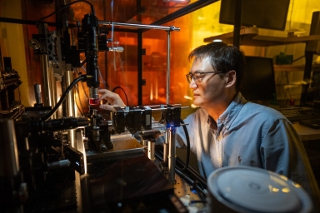
Sandia National Laboratories scientist Jongmin Lee adjusts a machine that produces optical nanofibers 200 times thinner than a human hair. When laser beams travel through the nanofiber, halos of light form very close to it, guiding atoms along its length for quantum sensing. [Credit: Photo by Craig Fritz/Courtesy of Sandia]
Their latest results were published in the journal AVS Quantum Science, where the team reported trapping cesium atoms on a fiber only 420 nanometers in diameter with just 5 milliwatts of optical power -- about 2,000 times less power than is used by an LED bulb. With just 150 nanowatts, the researchers can also take measurements that mimic atom interferometry.
They also reported a new design for a heat-resistant membrane-waveguide, a next-generation prototype. Nanofibers provide a convenient, reliable testbed for the team's atom-guiding experiments but currently are impractical for real-world use.
"Our ultimate goal is to demonstrate this on chip with a photonic integrated circuit, but our nanofiber results show a clear potential path toward chip-scale quantum inertial sensing," Lee said.
The new trapping method uses roughly one-sixth to one-fourth as much power as previous approaches, marking a significant advance toward rugged, chip-scale atom interferometers that could help military vehicles navigate when GPS signals are jammed.
The project was funded primarily by Sandia's Laboratory Directed Research and Development program.
Sandia tech could get pilots out of a jam
If you want to jam satellite navigation signals, just let out an electromagnetic scream. Overwhelmed by noise that drowns out signals from positioning satellites, an aircraft will have to rely on onboard acceleration and attitude sensors. This can work for a while, but eventually the aircraft will drift from its intended flight path.
Quantum sensing offers a potential solution. Its measurements use quantum mechanics and can be much more accurate than those from conventional instruments. An atomic clock, for example, is a well-known kind of quantum sensor that can keep accurate time far longer than a quartz wristwatch before its timekeeping begins to drift.
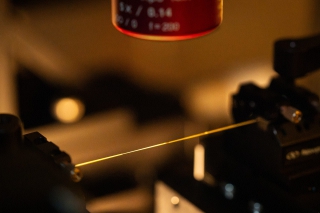
Standard optical fiber at Sandia National Laboratories is simultaneously heated over a flame and stretched by two motorized stages to produce an optical nanofiber. [Credit: Photo by Craig Fritz/Courtesy of Sandia]
Similarly, a quantum sensor that measures inertia could keep a vehicle on track much longer than current instruments when GPS is jammed or unavailable.
Tight light is not the only idea for propelling next-generation navigation, but it does offer a distinct benefit. For comparison, instead of thinking about marbles in a pipe, consider free-falling ones. This is the idea behind an alternative technology called a free-space atom interferometer. It releases ultracold atoms and uses laser pulses to measure their motion as they fall in a steady stream through a vacuum chamber. However, strong jolts or vibrations can cause lasers to momentarily lose sight of the atoms, disrupting measurements. By contrast, guided atom interferometry, like a narrow pipe, keeps atoms contained and therefore in constant view of the lasers.
Lee's guided concept, implemented on a photonic integrated circuit, is newer and less developed, but the physical guide offers a clear advantage because it holds onto the atoms even when the device is knocked around. That could be useful for navigation through strong turbulence or over rough roads.
However, Lee said, "This idea has not been fully realized by the community for decades, due to challenges in dissipating heat from photonic devices in vacuum and in efficiently loading atoms around them."
New component design balances tricky tradeoffs
The problem is lasers. You need them to create the halo effect that catches and guides atoms. However, the lasers also generate heat, and when you're dealing with ultrathin components -- 200 times thinner than a human hair -- heat builds up fast. It can crack the atom guide, like burning out the filament in an incandescent light bulb.
Until recently, scientists have had to choose between fragile designs that suspend waveguides to load atoms efficiently but shatter under high heat and sturdier designs that mount a waveguide on a solid substrate. These handle the heat well but load atoms poorly.
"Both heat dissipation and efficient atom loading are really important," Lee said.
The Sandia team found a solution with a platform that strikes a balance between the two approaches.
"What makes this new membrane-waveguide less susceptible to heat in a vacuum is that it is anchored on either end by small pins of silicon," Lee explained. Under a microscope, these little pins look enormous compared with the nano-thin membrane-waveguide. More importantly, they act as heat sinks, drawing heat away from the lasers.
Future plans
With heat no longer a deal-breaker, the Sandia team is now beginning to bring years of research together into a single workflow.
"Using laser cooling and trapping, our team produced a cloud of very cold, slow-moving atoms that drift into and accumulate within either a hole in the membrane or a gap between two silicon needles," Lee said.
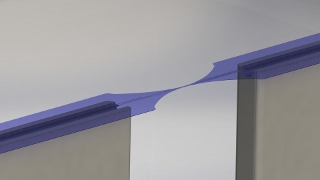
Future research at Sandia National Laboratories will involve generating cold atoms at the thinnest part of their newly designed membrane-waveguide and guiding them along the waveguide, shown in this rendering. For a guided atom interferometer, three rapid laser pulses delivered through the waveguide will split, redirect, and recombine the guided atoms. [Credit: Image by Michael Gehl/Courtesy of Sandia]
Spanning that hole or gap, the membrane-waveguide performs the same job as an optical nanofiber: It creates halos of light to guide the atoms.
"Building on our nanofiber results, we showed cesium atoms can be trapped with just five milliwatts of optical power and that atomic coherence can be measured using sub-microwatt fiber-coupled beams, all while minimizing in-vacuum heat loads," Lee said. "This capability is feasible on the membrane-waveguide photonic integrated circuit platforms developed at Sandia."
Lee is still working out some kinks in the membrane, which is why he tested his measurement protocols on a nanofiber testbed rather than on the new platform. However, future research will gather atom-trapping and power data on the new atom guide, add momentum kicks to the atoms during measurements, and integrate the guide with other components on a chip, moving closer to a chip-scale quantum inertial sensor array.
"Our concept is not fully demonstrated yet, but we're very close," Lee said.
For now, these atoms are buckled in and ready for the next stretch of quantum sensing, no matter what bumps in the road lie ahead.
Source: Sandia
Published October 2026
Rate this article
View our terms of use and privacy policy