 |
| October 06, 2026 | Volume 22 Issue 37 |
Designfax weekly eMagazine

Archives
Partners
Manufacturing Center
Product Spotlight
Modern Applications News
Metalworking Ideas For
Today's Job Shops
Tooling and Production
Strategies for large
metalworking plants
Vaporizing rock: Super-microwave drills go deep for geothermal drilling
Millimeter wave drilling technology pioneered at MIT is being combined with gyrotron technology developed for nuclear fusion research to produce equipment that will vaporize rock and drill ultra-deep geothermal wells. The super-blaster drilling apparatus is aimed at helping unlock the Earth's deep heat to deliver clean, reliable, baseload energy at scale.
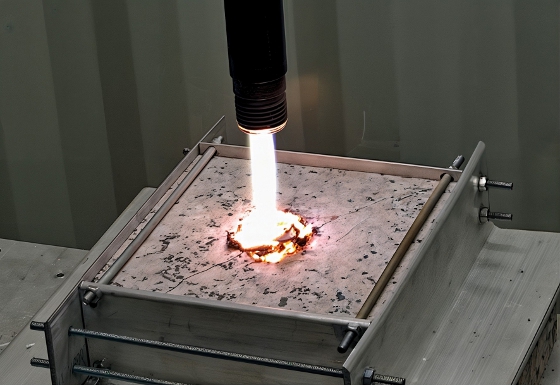
Millimeter wave drilling test in Quaise Energy's laboratory. [Credit: Quaise Energy]
Kyoto Fusioneering, located in Tokyo, has received an order from U.S.-based Quaise Energy, an MIT spinoff company, for a gyrotron system for use in Quaise's millimeter wave drilling technology. As both a technology innovator and project developer, Quaise builds and operates solutions that harness superhot geothermal energy far below the surface, enabling power generation that can rival the output of today's most efficient fossil fuel and nuclear plants. With its millimeter wave drilling technology, developed after more than a decade of research at MIT, Quaise's mission is to make superhot geothermal a backbone of the modern energy system, offering affordable, zero-carbon power and energy independence for communities and nations.
However, to blast through tons and tons of rock to get to the really deep depths, traditional drilling equipment, including giant metal drill bits, won't cut it.
Why can't drillers just melt away the rock? Wouldn't that be cool?
Well, that is the idea behind combining gyrotron technology developed for fusion energy with millimeter wave drilling. A gyrotron is a high-powered microwave generator used to heat plasma in fusion reactors.
Quaise's drilling system will use millimeter waves generated by a gyrotron to ablate rock, with the aim of reaching the depths and temperatures associated with superhot geothermal resources that conventional mechanical drilling cannot reach economically. Unlike conventional drilling, the method requires no moving parts or mechanical downhole hardware. The approach originated from more than a decade of research at the Massachusetts Institute of Technology.
According to Kyoto Fusioneering, "Microwave ovens heat food using electromagnetic waves -- a principle that also applies to gyrotrons. These devices generate microwaves to heat materials, much like their household counterparts. The key difference lies in power: a gyrotron can provide 1,000 to 2,000 times more power than a typical microwave oven, reaching outputs of up to 1 megawatt (MW)." Because fusion reactions require temperatures of over 100 million degrees Celsius (which is hotter than the sun's core), this type of technology, if made portable, could easily provide the heat needed to blast through super-hard materials.
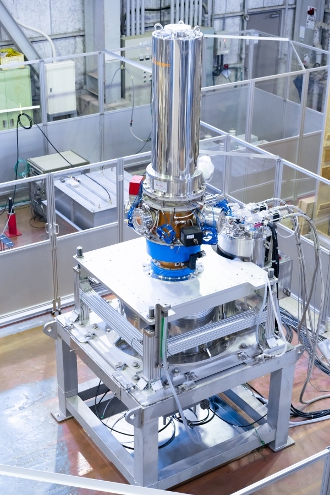
A Kyoto Fusioneering gyrotron installed in a test stand for factory acceptance testing. [Credit: Image courtesy of Kyoto Fusioneering]
The gyrotron is the enabling component. Megawatt-class millimeter wave sources have essentially one practical implementation, the gyrotron, and the industrial base that builds them exists because fusion needs it. Using the technology for drilling is a novel spinoff idea.
Kyoto Fusioneering designs and builds gyrotrons across frequencies from 28 GHz to 236 GHz, including multi-frequency tubes. Delivered systems aimed at fusion energy include two dual-frequency gyrotrons for the UK Atomic Energy Authority's MAST Upgrade, a 1-MW system for Tokamak Energy's ST40, and the first of two units for the U.S. Department of Energy's DIII-D National Fusion Facility. The company has also completed the design of a 1.5- to 2-MW-class gyrotron for the Wendelstein 7-X stellarator and ASDEX Upgrade at the Max Planck Institute for Plasma Physics.
Most of the fusion machines operating today are experimental devices that heat plasma in pulses lasting seconds. Drilling does not work that way. The millimeter wave source has to run continuously for as long as the hole is being advanced, and the unit Kyoto Fusioneering is supplying to Quaise is specified and designed on that basis. This, rather than the underlying physics, is what distinguishes a drilling gyrotron from the fusion heating gyrotrons Kyoto Fusioneering builds today.
The requirement is not unique to drilling. Fusion power plants will also need heating systems that run continuously; the pulsed duty cycles of the current research fleet are a property of today's machines, not of where the technology is going. Building a gyrotron for continuous operation for a geothermal customer is work directly relevant to fusion.
In September 2024, Kyoto Fusioneering was selected for NEDO's Deep-Tech Startups Support Program in the Green Transformation (GX) field (NEDO is Japan's national energy and industrial technology R&D funding agency) to develop high-power, continuous-operation gyrotrons and power supplies for superhot geothermal development. The Quaise order is the first commercial outcome of that work.
That industrial base for gyrotron development is small. Fusion plants will need it to grow substantially larger than it is today. Orders from outside fusion put work through the same design, engineering, and quality systems that fusion will require, which is how that capability gets built before fusion needs it rather than after.
Japan holds one of the world's largest geothermal resource bases, and its deep, high-temperature resources remain largely undeveloped because conventional drilling has not reached them economically. Japan's Ministry of Economy, Trade, and Industry and NEDO are supporting superhot geothermal, closed-loop systems and Enhanced Geothermal Systems under the Green Innovation Fund. KF intends to apply what it learns from this project to next-generation geothermal development in Japan.
VIDEO: Millimeter wave drilling -- the future of clean energy. [Credit: Quaise Energy]
According to Geothermal Rising, by targeting deep-Earth superhot conditions of 300-500 C, "each well can deliver 5-10 times the electricity of conventional geothermal systems."
"Conventional geothermal development typically reaches depths of about two kilometers and temperatures around 200 C," the Geothermal Rising site says. "The deeper and hotter you go, the physics improve: higher enthalpy fluids, greater density contrasts between injection and production, and more efficient power conversion at the surface. What has been missing is a drilling system that can survive and perform economically under those conditions."
In the Quaise system, a surface-based gyrotron generates the concentrated millimeter-wave energy. That energy is then transmitted down a metal waveguide to the rock face. The process reportedly undergoes minimal energy loss.
VIDEO: From lab to field testing of millimeter wave drilling. [Credit: Quaise Energy]
According to Geothermal Rising, "At the bottom of the hole, the directed energy ablates rock through thermal spallation and vaporization rather than mechanical grinding. No rotating bit contacts the formation. Because the energy source sits at the surface, it is not exposed to downhole temperatures or pressures. Cuttings are removed by a pressurized purge gas system rather than heavy drilling mud, eliminating many of the circulation challenges that plague deep conventional wells.
"The system has already penetrated more than 100 meters through granite in field conditions [Project Obsidian in Central Oregon], proving the approach works in the crystalline basement lithologies where superhot rock is found. That milestone moved the technology from laboratory demonstration to field validation."
According to Quaise, their "gyrotron-powered drilling platform vaporizes boreholes through rock and provides access to deep geothermal heat without complex downhole equipment." At depths from 3 to 20 km, superhot geothermal energy spots can be reached anywhere on Earth. The company says, "For the upper layers of the crust (the first few kilometers), Quaise uses conventional rotary drilling equipment and infrastructure before transitioning to their surface gyrotron-powered millimeter wave system for the extreme depths."
VIDEO: How to build a superhot geothermal power plant. [Credit: Quaise Energy]
A 2024 article in IEEE Spectrum about earlier developments explains, "A gyrotron uses high-power, linear-beam vacuum tubes to generate millimeter-length electromagnetic waves." The system also depends on injected gas "to quench and carry out ash" after vaporizing rock. The geothermal power that the technology has the potential to tap may be able to replace fossil fuels in many important applications. The IEE article also states the deepest man-made hole ever drilled was made in Siberia with a depth of 12,262 m.
Electrical power from a local grid can drive the gyrotron equipment if the drilling occurs close enough to a power plant. For field operations, the energy needed is produced by high-output industrial diesel or gas generators.
We will have to wait and see if the tech is truly viable and produces as promised.
Designfax Editor's Note: The Quaise Energy YouTube channel has a variety of in-depth videos on the technology. Please check it out.
Sources: Kyoto Fusioneering, Quaise Energy, Geothermal Rising (geothermal.org), IEEE Spectrum
Published October 2026
Rate this article
View our terms of use and privacy policy