 |
| October 06, 2026 | Volume 22 Issue 37 |
Designfax weekly eMagazine
Archives
Partners
Manufacturing Center
Product Spotlight
Modern Applications News
Metalworking Ideas For
Today's Job Shops
Tooling and Production
Strategies for large
metalworking plants
NASA pushes new wing design to its limits
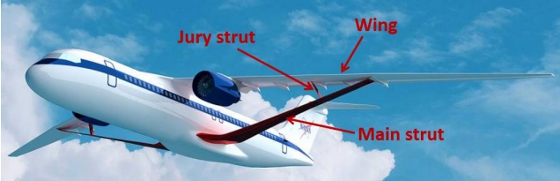
The Armstrong Flight Research Center (AFRC) is using a test article to explore behavior anticipated in the X-66 TTBW demonstrator supported by the Flight Demonstration Capabilities (FDC) program. The technology centers around a transonic truss-braced wing, shown here from a Jan. 2025 NASA presentation titled "Structural Sizing of a Tow-Steered Truss-Braced Wing Box Test Article." [Credit: NASA presentation by Brian H. Mason, Erin K. Anderson, Alana M. Cardona, Christine V. Jutte, and Richard A. Larson of NASA Langley Research Center. AIAA Science and Technology Forum and Exposition, Orlando, FL, January 6-10, 2025]
By Sarah Mann, NASA Armstrong
NASA researchers recently put a new wing design, appearing long and thin with a lightweight structure, through a series of grueling tests to find its structural limits. What they found left them encouraged about the wing's potential, even when they pushed it past its intended limits.
The 15-foot Structural Wing Experiment Evaluating Truss-bracing (SWEET-15) test article is part of NASA's research to develop future ultra-efficient aircraft. The design incorporates a long wing supported by an aerodynamic strut, based on NASA's earlier Transonic Truss-Braced Wing concept.
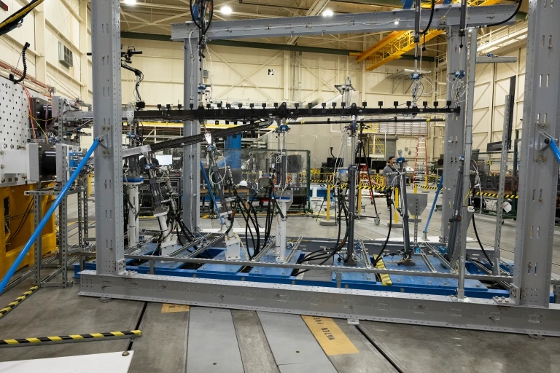
The 15-foot Structural Wing Experiment Evaluating Truss-bracing test article is fully installed in the Flight Loads Laboratory at NASA's Armstrong Flight Research Center in Edwards, California, on Wednesday, May 20, 2026. The model is part of NASA's research to develop technologies for future ultra-efficient aircraft. [Credit: NASA/Carla Escamilla]
The research team is working to understand whether SWEET-15's design and its new lightweight structural designs could help commercial airliners save fuel. But first, they need to understand how it behaves under the kinds of force wings experience in flight.
The SWEET-15 design originated with combining five different advanced composite manufacturing and assembly technologies that enabled the novel structural design. The 15-foot-long test article was then designed and fabricated at NASA's Langley Research Center in Hampton, Virginia, before traveling to NASA's Armstrong Flight Research Center in Edwards, California, for testing.
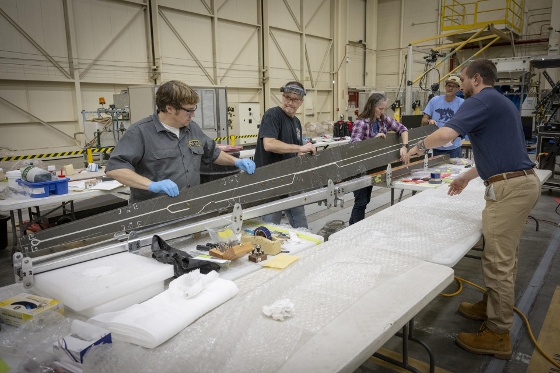
Lab technicians Phil Tofts, Chris McLain, and Jeff Howell and NASA engineers Erin Anderson and Richard Larson prepare the 15-foot Structural Wing Experiment Evaluating Truss-bracing model in the Flight Loads Laboratory at NASA's Armstrong Flight Research Center in Edwards, California, on Thursday, Dec. 11, 2025. The model is part of NASA's research to develop technologies for future ultra-efficient aircraft. [Credit: NASA/Christopher LC Clark]
Over several months, NASA engineers intentionally bent the test wing in the Flight Loads Laboratory at NASA Armstrong. Numerous strain and load sensors, including fiber-optic strain sensors, were placed throughout the structure to track how the wing responded as forces increased.
The data from the sensors confirmed the predictions made by NASA's computer models. According to initial findings, the wing withstood the anticipated in-flight forces without issue. The results provided the team with confidence in the new manufacturing approaches and methods for connecting wing parts used in SWEET-15, which could support future efficient aircraft designs. The manufacturing approach used the Integrated Structural Assembly of Advanced Composites (ISAAC) robot, which was developed at NASA Langley and aims to produce lighter and stronger composite structures for aerospace vehicles.
VIDEO: See the NASA Langley-developed Integrated Structural Assembly of Advanced Composites (ISAAC) robot in action. [Credit: NASA Langley Research Center]
The test concluded with a deliberate test-to-failure, where engineers increased loads beyond the wing's design limits to determine how and where it would fail. The structure ultimately failed at roughly 127% of its design limit load, with visible damage appearing near the back edge of the wing and in the upper wing cover. This element of testing provided valuable insight into how the joints connecting the wing to its main strut and a secondary one, called a jury strut, behave under forces beyond the expected flight envelope.
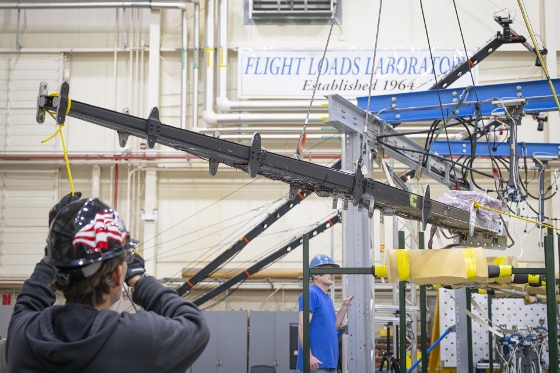
Lab technicians Jeff Howell (left) and Chris Mount install the 15-foot Structural Wing Experiment Evaluating Truss-bracing model in the Flight Loads Lab at NASA's Armstrong Flight Research Center in Edwards, California, Wednesday, February 11, 2026. The model is part of NASA's research to develop technologies for future ultra-efficient aircraft. [Credit: NASA/Christopher LC Clark]
This marks the first time a representative composite truss-braced wing configuration has undergone this type of structural evaluation. It was made possible only through NASA collaboration across centers and projects, with researchers utilizing agency resources such as the Fiber Optic Sensing System developed to gather data on both aircraft and spacecraft.
To prepare for the testing, engineers at NASA Langley designed, analyzed, and manufactured the wing and completed safety preparations and lab setup.
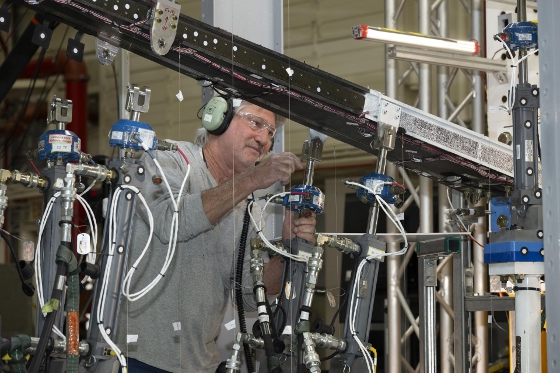
NASA research engineer Walter Hargis regulates the 15-foot Structural Wing Experiment Evaluating Truss-bracing model in the Flight Loads Laboratory at NASA's Armstrong Flight Research Center in Edwards, California, on Tuesday, March 31, 2026. The model is part of NASA's research to develop technologies for future ultra-efficient aircraft. [Credit: NASA/Ryan Kline]
Researchers will now analyze the data collected during testing to inform future airframe designs and support NASA's ongoing efforts to develop more efficient aviation technologies.
The work is being conducted through NASA's Subsonic Flight Demonstrator project in the agency's Research Technology Mission Directorate. The successful testing of multiple innovative components marks a milestone in NASA's aeronautics research.
We are grateful to NASA to be able to share these articles with you. To learn more about this topic, visit nasa.gov/aeronautics/.
Published October 2026
Rate this article
View our terms of use and privacy policy