 |
| October 06, 2026 | Volume 22 Issue 37 |
Mechanical News & Products

Designfax weekly eMagazine
Archives
Partners
Manufacturing Center
Product Spotlight
Modern Applications News
Metalworking Ideas For
Today's Job Shops
Tooling and Production
Strategies for large
metalworking plants
Holding firm: Standard parts with increased clamping force
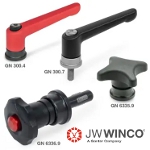 JW Winco has upgraded its proven hand knob nuts, star knob screws, and adjustable hand levers with increased clamping force. Their clamping surface with ball bearing doubles the clamping force while protecting the surface from damage. With typical screws and nuts, roughly half the tightening torque is lost to under-head friction. Get high axial clamping force purely by hand and without tools with these new JW Winco standard parts.
See all your new clamping options.
Cool! Internal threading in hard materials now possible
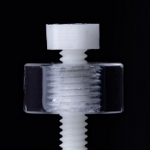 INSACO has a new capability where they can machine an internal thread in ceramic, sapphire, quartz, and other very hard materials. This advance pushes the boundaries of what's possible to support advanced applications that demand high precision and complexity. Ultra-hard materials are alternatives for when metal can't do the job. Ideal for aerospace, medical, and industrial applications.
Learn more. Video available on right side of page.
Sealing fasteners can optimize your designs
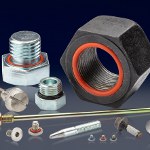 Highly specialized sealing fasteners include sealing screws, sealing nuts, sealing bolts, and sealing washers. Unlike ordinary fasteners, sealing fasteners are configured with a rubber O-ring (or a rubber element) that, when squeezed, permanently seals out a wide range of contaminants from entering and damaging equipment while preventing leakage of toxins into the environment. ZAGO sealing fasteners are designed to withstand harsh weather and extreme temperatures and are vibration and pressure resistant.
Learn all about ZAGO's wide selection of sealing fasteners.
New and improved: Electronic flow control for smarter compressed air use
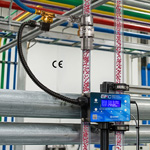 EXAIR's newly redesigned EFC™ Electronic Flow Control makes it easier than ever to minimize compressed air use in automated industrial processes. The EFC pairs a photoelectric sensor with programmable timing control to automatically turn on compressed air only when needed, eliminating waste during production gaps. The latest design introduces asynchronous timing for greater control over operating cycles, convenient external programming that eliminates the need to remove the enclosure cover to make adjustments, and a sleek new appearance.
Learn more.
SOLIDWORKS: Mastering sheet metal -- advanced tips and tricks
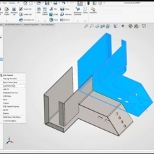 GoEngineer's Brady Daniels, Senior Applications Engineer, gives a master class in next-level sheet metal design. This on-demand webinar covers practical tips and techniques aimed at expanding your understanding and improving real-world workflows. Topics include bend calculations, comparing design approaches, how flat patterns work, and embracing multi-body design. Skip through or take in the whole presentation when you have time. [Credit: Screenshot courtesy of GoEngineer]
View the GoEngineer video.
14 years in a row! Smalley recognized with GM Supplier Quality Excellence Award
 Kudos to the team at Smalley! A continued focus on quality, consistency, and customer support has earned the company -- a world leader in retaining rings and wave springs -- the General Motors' 2025 Supplier Quality Excellence Award, marking the company's 14th consecutive year receiving the hard-to-win recognition.
Read the full article.
Award-winning bio-based instant engineering adhesive resists heat and humidity
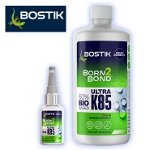 Bostik has launched Born2Bond™ Ultra K85, the first-ever instant engineering adhesive processed from 60% bio-based raw materials. This material has been created for design engineers, product designers, and manufacturers looking for an ultra-durable adhesive that provides exceptional resistance to humidity and high temperatures. It delivers premium performance -- even bonding dissimilar materials -- while not compromising on safety, health, or the environment. It earned the Adhesive & Sealant Industry's 2026 Innovation Award.
Learn more.
Siemens Meet at the Machine: Be productive from day one of new CNC machine delivery
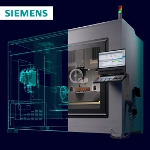 Traditionally, many programming, validation, and training activities begin only after a machine is installed. Not anymore. Meet at the Machine is Siemens' new initiative uniting machine builders, software, and automation for next-level CNC through a continuous digital thread across engineering, programming, virtual validation, and execution. By pairing a Digital Twin with Digital CNC powered by SINUMERIK, manufacturers can prepare, validate, train, and optimize workflows before your specialized machine's physical delivery! TRAK Machine Tools is the launch partner -- see what they are doing.
Learn more.
How to master metal powder management in 3D printing
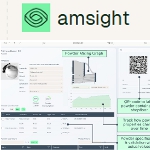 What's the real cost of "good enough" powder tracking for powder-bed fusion 3D-printing machines? According to Tim Wischeropp, CEO and Co-Founder of amsight, the technology is rife with hidden costs. Every cycle, every handling step, every exposure, and every mixing decision plays a part. Surprisingly, though, with the right strategy, users can turn their losses into a competitive edge. Learn how.
Read the full article.
Aluminum oxide filament for FDM printers
 Virtual Foundry, the company that brought us 3D-printable lunar regolith simulant, has a new product called Aluminum Oxide Filamet™, giving users the power to print alumina parts using the FDM printers they already own. This composite 3D-printing material allows researchers, engineers, and makers to bypass expensive ceramic tooling and produce pure ceramic components in-house. Print using a 0.6-mm hardened-steel, standard-flow nozzle on virtually any open-architecture printer.
Get all the material specs.
New metal extrusion retrofit system helps manufacturers get into ShAPE
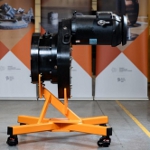 A new invention from the Department of Energy's Pacific Northwest National Laboratory could soon help manufacturers more easily adopt the lab's patented Shear Assisted Processing and Extrusion (ShAPE™) technology, enabling faster manufacturing of superior extrusion products while reducing costs and energy use.
Read the full article.
Pneumatics: Dual guide rod cylinders and exhaust silencers
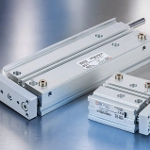 Automation-Direct has expanded its guided actuator lineup with compact 12-mm dual guide rod cylinders from Metal Work. Ideal for packaging and material handling, these double-acting cylinders feature 10-mm to 250-mm strokes, magnetic pistons, and integral sensor slots. Additionally, new durable acetal plastic silencers are now available in multiple NPT/BSPP sizes to reduce pneumatic exhaust noise.
Learn more.
Expanded injection molding capabilities
 Pexco LLC has acquired Recto Molded Products and Legacy Extrusions, expanding its capabilities in complex injection molding, tooling, assembly, and engineered thermoplastic solutions for OEM manufacturers. The Cincinnati-based companies bring more than a century of manufacturing expertise, advanced production technologies, and value-added services that strengthen Pexco's ability to support customers from product design through full-scale production. Injection molding presses ranging from 55 to 500 tons.
Learn about Pexco and its value-added manufacturing services.
Custom 3D-printed steering wheel for jet dragster
 Jet dragsters use General Electric J85 engines -- the same turbines pulled from U.S. military F5 Freedom Fighters -- mounted to a custom 26-ft chassis. The racers achieve quarter-miles in 5.5 sec, but standard metal parts can fail custom ergonomic needs. Traditional manufacturing of low-volume aluminum steering wheels demands long, 8-day lead times, high costs, and multi-piece assemblies. Larsen Motorsports solved this by replacing metal with continuous fiber 3D printing using the Markforged X7. Embedding continuous carbon fiber into an Onyx nylon matrix allowed them to target specific load paths, delivering a custom steering wheel that is stiffer, lighter, and faster to produce than aluminum.
View the video.
Application Spotlight: Light-duty ring in an air vent nozzle
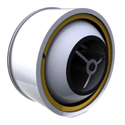 Explore how a light-duty Spirolox® retaining ring is used in an airplane air vent nozzle to regulate airflow. This application spotlight shows how the ring fits into a groove in the plastic housing, securing the nozzle during rotation. Designed for light loads and axial positioning, it offers a simple, economical solution that is easy to install and remove.
View this informative Smalley video.
'Super Steel' team develops new ultra stainless steel for hydrogen production
A research project led by Professor Mingxin Huang at the Department of Mechanical Engineering of the University of Hong Kong (HKU) has made a brand-new breakthrough over conventional stainless steel and the development of stainless steel for hydrogen (SS-H2).
This marks another major achievement by Huang's team in its "Super Steel" project, following the development of the anti-COVID-19 stainless steel in 2021 and ultra-strong and ultra-tough Super Steel in 2017 and 2020, respectively.
The new steel developed by the team exhibits high corrosion resistance, enabling its potential application for green hydrogen production from seawater, where a novel sustainable solution is still in the pipeline.
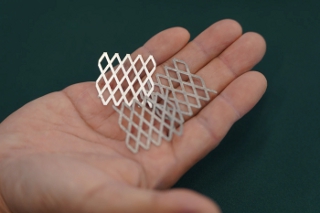
The novel stainless steel for hydrogen developed by the team. [Credit: Image courtesy of University of Hong Kong]
The performance of the new steel in saltwater electrolyzer is comparable to the current industrial practice using titanium as structural parts to produce hydrogen from desalted seawater or acid, while the cost of the new steel is much cheaper.
The discovery has been published in Materials Today in the paper titled "A sequential dual-passivation strategy for designing stainless steel used above water oxidation." The researchers are currently applying for patents in multiple countries. Two of them have already been granted authorization.
Since its discovery a century ago, stainless steel has always been an important material widely used in corrosive environments. Chromium is an essential element in establishing the corrosion resistance of stainless steel. Passive film is generated through the oxidation of chromium (Cr) and protects stainless steel in natural environments. Unfortunately, this conventional single-passivation mechanism based on Cr has halted further advancement of stainless steel. Owing to the further oxidation of stable Cr2O3 into soluble Cr(VI) species, tranpassive corrosion inevitably occurs in conventional stainless steel at ~1,000 mV (saturated calomel electrode, SCE), which is below the potential required for water oxidation at ~1,600 mV.
254SMO super stainless steel, for instance, is a benchmark among Cr-based anti-corrosion alloys and has superior pitting resistance in seawater; however, transpassive corrosion limits its application at higher potentials.
By using a "sequential dual-passivation" strategy, Huang's research team developed the novel SS-H2 with superior corrosion resistance. In addition to the single Cr2O3-based passive layer, a secondary Mn-based layer forms on the preceding Cr-based layer at ~720 mV. The sequential dual-passivation mechanism prevents the SS-H2 from corrosion in chloride media to an ultra-high potential of 1,700 mV. The SS-H2 demonstrates a fundamental breakthrough over conventional stainless steel.
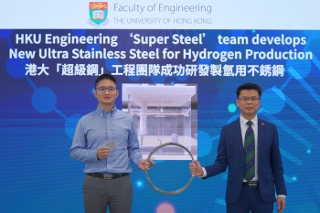
Dr. Kaiping Yu (left) and Professor Mingxin Huang. [Credit: Image courtesy of University of Hong Kong]
"Initially, we did not believe it because the prevailing view is that Mn impairs the corrosion resistance of stainless steel. Mn-based passivation is a counter-intuitive discovery, which cannot be explained by current knowledge in corrosion science. However, when numerous atomic-level results were presented, we were convinced. Beyond being surprised, we cannot wait to exploit the mechanism," said Dr Kaiping Yu, the first author of the article, whose PhD is supervised by Professor Huang.
From the initial discovery of the innovative stainless steel to achieving a breakthrough in scientific understanding, and ultimately preparing for the official publication and hopefully its industrial application, the team devoted nearly six years to the work.
"Different from the current corrosion community, which mainly focuses on the resistance at natural potentials, we specialize in developing high-potential-resistant alloys. Our strategy overcame the fundamental limitation of conventional stainless steel and established a paradigm for alloy development applicable at high potentials. This breakthrough is exciting and brings new applications." Professor Huang said.
At present, for water electrolyzer in desalted seawater or acid solutions, expensive Au- or Pt-coated Ti are required for structural components. For instance, the total cost of a 10-megawatt PEM electrolysis tank system in its current stage is approximately HK$17.8 million, with the structural components contributing up to 53% of the overall expense. The breakthrough made by Professor Huang's team makes it possible to replace these expensive structural components with more economical steel. As estimated, the use of SS-H2 is expected to cut the cost of structural material by about 40 times, demonstrating a great savings for industrial applications.
"From experimental materials to real products, such as meshes and foams for water electrolyzers, there are still challenging tasks at hand. Currently, we have made a big step toward industrialization. Tons of SS-H2-based wire has been produced in collaboration with a factory from the Mainland. We are moving forward in applying the more economical SS-H2 in hydrogen production from renewable sources," said Professor Huang.
Source: University of Hong Kong
Published October 2026
Rate this article
View our terms of use and privacy policy