 |
| November 03, 2026 | Volume 22 Issue 40 |
Designfax weekly eMagazine

Archives
Partners
Manufacturing Center
Product Spotlight
Modern Applications News
Metalworking Ideas For
Today's Job Shops
Tooling and Production
Strategies for large
metalworking plants
What's ETCRAM memory? New analog memory doesn't use 1s and 0s, may make smart devices even smarter
A new approach to computing has quietly taken shape at Sandia National Laboratories, where researchers have developed a way to store information that could make future electronics more energy efficient.
Electro-thermo-chemical random-access memory, or ETCRAM, works differently from conventional digital memory, which represents information as ones and zeros on silicon wafers. Instead of being limited to two values, ETCRAM can store a range of analog values by using localized heating and electrical pulses to change the properties of materials inside the device.
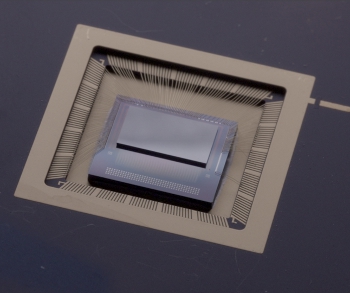
Electrothermochemical random access memory chips are able to achieve 100 times higher precision than existing state-of-the-art technology. [Credit: Photo by Ruth Frank/Courtesy of Sandia]
The team, led by Sandia researchers Elliot Fuller and Alec Talin, demonstrated the approach using tantalum and vanadium oxide materials. The result is a memory technology capable of storing information with far greater precision and dynamic range than existing analog memory technologies. Because the device can hold many distinct analog states rather than simply switching between zero and one, researchers are exploring whether it could perform some computing tasks with less energy.
"The technology that we've developed is designed to overcome a limitation of our existing computing technology to really improve energy efficiency," Fuller said. "ETCRAM is able to achieve 100 times higher precision than existing state-of-the-art technology -- and at least three orders of magnitude greater dynamic range. That's the value of a number that you can store in analog."
That potential matters for the nation as the amount of energy required for computing continues to grow. The U.S. Energy Information Administration projects that electricity consumed by data center servers could reach roughly 800 billion kilowatt-hours annually by 2050 in a high-demand scenario.
Perhaps surprisingly, one of the easiest ways to understand ETCRAM is to think about a battery.
"You can think of ETCRAM as a memory device," Talin explained. "You can charge a battery halfway and then stop charging and use that energy. Think of the state of the battery as a memory. It stores that state."
The team started with what researchers already know about the properties of materials used in batteries. However, materials that are good at storing energy are not necessarily well suited to storing information. Lithium ions, for example, are useful for energy storage but not ideal for the kind of data storage the Sandia team was pursuing.
"We want to store the maximum amount of information density in a particular volume," Fuller said. "The challenge with electrochemistry is often how slowly it works. The trick with getting this memory element to work was to have it self-heat. It heats up when the electrochemistry is activated, and that's what gives us this very large dynamic range and allows it to have very high precision."
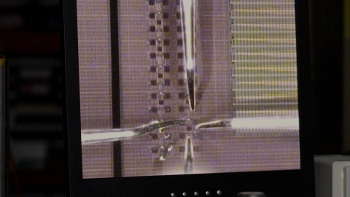
The team responsible for developing ETCRAM is now working to test designs with multiple materials to further improve the technology. [Credit: Photo by Arianna Andreatta/Courtesy of Sandia]
That self-heating helps speed the electrochemical process used to program the memory.
The team is also looking at how the technology could support edge computing, in which information is processed close to where it is collected rather than always being sent to a central processor or remote computing system.
Consider a smartphone camera. The sensor captures light, and the phone performs most image processing locally using dedicated hardware before the final image appears. In edge/near-sensor computing, more of this processing -- or higher-level analysis -- could be moved even closer to the sensor, potentially including analog or mixed-signal processing on the sensor itself, so less raw data needs to be transmitted elsewhere.
Doing more computation where data are collected could help improve both speed and energy efficiency, particularly as sensors become more common in everyday devices.
"We live in the 21st century, and there are electronics all around us," said postdoctoral researcher Adam Gross. "You wake up in the morning, and there's an alarm clock or your phone that has light sensors and sound sensors. Modern cars are outfitted with a suite of sensors. The number of sensors in so much of what modern life requires are all opportunities where our device could potentially make a difference."
Funded by Sandia's Laboratory Directed Research and Development program and the Department of Energy's Office of Science, ETCRAM was named a finalist for a 2026 R&D 100 Award.
For Fuller, Talin, and their colleagues, the work is ultimately about finding new ways for increasingly capable electronics to handle more information without requiring proportionally more energy. ETCRAM is one approach they hope could help bring more of that computing directly to the sensors and devices already woven into everyday life.
Source: Sandia National Laboratories
Published November 2026
Rate this article
View our terms of use and privacy policy