 |
| November 03, 2026 | Volume 22 Issue 40 |
Designfax weekly eMagazine

Archives
Partners
Manufacturing Center
Product Spotlight
Modern Applications News
Metalworking Ideas For
Today's Job Shops
Tooling and Production
Strategies for large
metalworking plants
Weird science: Music can enhance the flavor of your food
The moment we take a sip of our morning coffee or our first bite of lunch, the brain begins interpreting what we taste. Is it sweet? Is it sour? Is it something else entirely?
Interestingly, the brain does not create flavor based solely on signals from the tongue. That is the finding of a new study from the Department of Food Science, published in the scientific journal Scientific Reports.
"When music reaches the ears at the same time as we are eating, we can see that the brain responds more strongly than when taste is experienced without music," says first author and postdoctoral researcher Alberte Baggesgaard Seeberg from the Department of Food Science at the University of Copenhagen in Denmark.
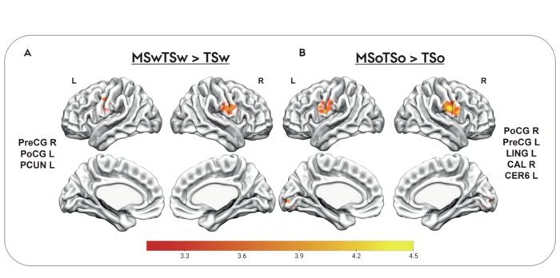
This figure shows what happens in the brain when taste is combined with music. On the left (A), sweet taste is paired with music associated with sweetness and compared with sweet taste alone. On the right (B), the same comparison is shown for sour taste. The yellow and orange areas indicate regions where the brain responds more strongly when music and taste are experienced together. These include areas involved in processing taste and sensory signals from the mouth. The findings show that what we hear can influence how the brain processes what we taste. [Credit: Seeberg et al. (2026)/Courtesy of University of Copenhagen]
Using brain scans, the researchers show that music can activate some of the same brain regions involved in processing taste.
"This tells us that flavor is not simply a property of food. Flavor is an experience created by the brain," says senior author and associate professor Janice Wang.
A breakthrough in brain imaging
It has long been known that music can alter the perception of flavor. This effect is known as sonic seasoning. What is new is that researchers have now linked this effect to direct measurements of brain activity. The new brain scans support previous research in the field.
This is the first time researchers have used brain imaging to show what happens in the brain when it processes taste. In the study, they used functional magnetic resonance imaging (fMRI), which measures activity in different parts of the brain by detecting changes in blood flow.
"This allows us to move beyond simply asking people about their experiences, which has been the approach in previous studies. With brain scans, we gain a biological window into what happens when the senses interact," says Alberte Baggesgaard Seeberg.
While participants lay in the scanner, their brain activity was measured under different conditions. In some cases, they listened only to music. In others, they tasted flavor solutions. In some trials, music and taste were presented simultaneously. This enabled the researchers to compare how the brain responds to sound and taste separately and in combination.
The results clearly showed that certain brain regions were more active when participants listened to music while tasting one of the two flavor solutions.
"We can see that flavor is constructed by the brain and not only by the taste buds. What determines flavor is not limited to what happens on the tongue. It emerges through the integration of multiple senses," says Wang.
The findings build on previous studies showing that music can enhance particular taste perceptions. For example, slow pop music with harmonious tones may enhance sweetness. Until now, however, this has only been investigated through behavioral studies in which participants rated flavors with and without music.
Shaping flavor experiences could improve well being
According to the researchers, the new knowledge could be used to design better eating experiences in a range of settings, including restaurants, canteens, and hospitals.
"For people who are at risk of malnutrition, something as simple as music could potentially improve the eating experience. There is a great deal we can do, often at very little cost, to improve quality of life for some people," says Seeberg.
Wang says she is pleased that, after many years of research into flavor and sensory perception, the team can now present biological evidence of how the senses interact. "We now have a new way of influencing flavor perception, creating a better meal experience and potentially a better overall experience, without necessarily changing the food itself," she says.
Source: University of Copenhagen
Published November 2026
Rate this article
View our terms of use and privacy policy